|
|
Research
Following are my research
interests:
· population genetics of forest tree
species; · conservation biology, especially the genetic conservation
of rare tree species; · landscape ecology; · population
genetics-related mathematical modeling.
Below is further
information about current and recent research
projects.
Evolutionary History and Genetic Conservation of Fraser Fir (Abies fraseri)

For link to a PDF version of my dissertation at the NCSU Libraries, click here.
Academic
advisor:
Dr. John
Frampton, associate professor of forestry and director of the
North Carolina State University Christmas
Tree Genetics Program
Graduate committee
members:
Dr. George R.
Hess, associate professor of forestry, North Carolina State
University
Dr.
Michael D. Purugganan, associate professor of genetics, North
Carolina State University
Dr.
Jenny Xiang, assistant professor of botany, North Carolina State
University
Doctoral dissertation abstract:
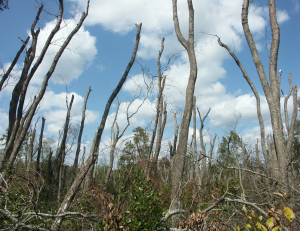
Fraser fir (Abies fraseri [Pursh] Poir.) is a glacial relict species endemic to high peaks in the Southern Appalachians. A conifer with considerable ecological and economic importance, it has been devastated by the infestation of the balsam woolly adelgid (Adelges piceae Ratz.), an exotic insect from Europe. I developed a series of stage-structured population matrix models for Fraser fir to simulate genetic dynamics in a long-lived forest tree species with overlapping generations. The results suggest that Fraser fir populations are large enough and its life cycle is long enough to avoid significant genetic drift, absent repeated adelgid infestations. The model results indicate that other forces, including natural selection and inter-population pollen exchange, are more likely to have influenced the genetic structure of the species.
I used microsatellite molecular markers to assess the genetic structure and genetic diversity of Fraser fir populations. This analysis found only slight differentiation among populations, but greater inbreeding and less observed heterozygosity than in other conifers. No genetic diversity measure was correlated with population size, suggesting that smaller populations did not suffer more extensively from detrimental genetic effects following post-Pleistocene fragmentation. While some gene flow may occur between populations in close proximity, the genetic architecture of the species is more likely a function of its post-glacial migratory history. Unexpectedly, some of the smallest Fraser fir populations were the most genetically diverse by some measures, and the largest and least isolated populations were among the least diverse.
Using the same microsatellite loci, I detected a relatively small amount of differentiation among Fraser fir, balsam fir (Abies balsamea [L.] Mill.), and intermediate fir (A. balsamea var. phanerolepis Fern.), suggesting that these taxa should be treated as varieties of the same species. Balsam fir appears to consist of three demes, suggesting the possibility of one large central fir refuge during the Pleistocene, with smaller refugia to the east and west. Fraser fir, with highly exserted and reflexed cone bracts, may represent an adaptive extreme of balsam fir that, during post-Pleistocene isolation, lost genetic contact with relatives lacking exserted bracts. The results also indicated the probable introgression of subalpine fir (A. lasiocarpa [Hook.] Nutt.) genes into balsam fir.
I conclude that in situ conservation of Fraser fir’s genetic composition is currently adequate, but may be insufficient in the face of global climate change and repeated adelgid infestations. A concerted ex situ strategy is needed to thoroughly conserve the genetic diversity of the species. I developed such a strategy for Fraser fir with two objectives: (1) to preserve its natural population genetic diversity in case Fraser fir populations are extirpated or degraded, and (2) to conserve and make available Fraser fir genetic resources for the breeding of an economically important tree species. The ex situ gene conservation strategy has four central components: (1) a seed bank representing all the Fraser fir populations, (2) existing elements of tree breeding efforts, (3) conservation plantings, and (4) an archive of Fraser fir DNA.
Return to
top
Phytophthora Root Rot Mortality in Fraser Fir: Genetic
Variation in an Infested Progeny Test

Research project
with Dr. John
Frampton
Overview:
Fraser fir (Abies fraseri
(Pursh.) Poir.), which is native to a small number of isolated ridgetops
in North Carolina, Tennessee, and Virginia, is widely grown in the
Southern Appalachians for the fresh-cut Christmas tree market.
Phytophthora root rot presents a serious economic limitation to these
Christmas tree growers, with the majority of root rot damage caused by
Phytophthora cinnamomi Rands. In 2000, a Fraser fir progeny test in
Avery County, North Carolina, was unintentionally infested by P.
cinnamomi. Using data from the 94 open-pollinated families at the test
site, we analyzed seedling mortality with three objectives: 1) to analyze
the genetic variation within the six major Fraser fir subpopulations for
potential Phytophthora root rot resistance, 2) to estimate genetic
parameters for these traits; and 3) to explore using a Geographic
Information System (GIS) neighborhood analysis as a tool for separating
potential genetic resistance to Phytophthora from uneven exposure to the
pathogen.
Family within source was the only variance component
significantly different from zero. When the populations were analyzed
separately, family variance was also significant in some sources. The
results from these analyses, and from future analyses of additional
mortality at the site, were compared to results from a greenhouse
inoculation test in progress during the summer of 2003. In this test,
Fraser fir from 120 families and all six seed sources are being inoculated
with a single P. cinnamomi isolate.
Our GIS analysis generated
information on the proportion of dead trees near each individual in the
plot. When we used this data as a covariate term in our genetic analysis
of variance, the results did not result in different variance estimates
and genetic parameters than without the use of the GIS-generated
neighborhood mortality data. This may indicate that the single-tree
non-contiguous plot design for the field study worked to reduce
differences in Phytophthora exposure among Fraser fir
families.
Return to
top
Landscape Characteristics and North Carolina Stream life:
A Multiple-Scale Ecological Risk Assessment of Nonpoint Source
Pollution

For link to a PDF version of my master's
thesis at the NCSU Libraries, click here.
Academic advisor:
Dr. Frederick W.
Cubbage, professor and department head of forestry, North
Carolina State University
Graduate committee
members:
Dr. Gary B.
Blank, associate professor of forestry, North Carolina State
University
Dr. George R.
Hess, associate professor of forestry, North Carolina State
University
Master's thesis
abstract:
Nonpoint sources of pollution may be
responsible for as much as 50 percent of current water quality degradation
in the United States, and as much as 70 percent in the Southeast. In this
study, I used an ecological risk assessment methodology, at the watershed
scale and riparian scales (zones 300, 100, and 50 feet on either side of
streams), to analyze and quantify the impact of nonpoint pollution on the
ecological integrity and water quality of North Carolina streams.
Specifically, I determined how land-use patterns relate to aquatic
ecological integrity, including the extent to which one of the most widely
promoted best management practices (BMPs) - the preservation of riparian
vegetated buffers - correlates with better ecological integrity. The
central goal of this project was the creation of a set of empirical models
that describe the vulnerability of North Carolina aquatic ecological
integrity - as measured by benthic macroinvertebrate community structure -
to changes in the landscape-scale sources of nonpoint pollution. The
models, the result of multiple regression analysis of Geographic
Information System (GIS)-derived data, take into account watershed land
form characteristics and three land cover types: forest, urban, and
agriculture. The results can be used by managers and policymakers to weigh
the risks of management and policy decisions for a given watershed or set
of watersheds, including whether vegetated riparian buffers are
ecologically effective and economically efficient in achieving water
quality standards.
The results of this study indicate that (1)
landscape characteristics at the watershed scale predict variability in
benthic macroinvertebrate community structure better than characteristics
at the riparian scale; (2) land cover variables are of secondary
importance to certain land form features, but are still significant
predictors of macroinvertebrate community structure; (3) developed land
use is the most important land cover variable at the watershed scale,
while forested land cover is the most important at the riparian scale; (4)
wider riparian buffer zones yield only minor differences in invertebrate
community structure; and (5) more research is needed on how these
interactions vary by the size of a watershed and the ecoregion in which it
is located.
The ecological risk assessment process that produced
these results was relatively simple and inexpensive. The results are
straightforward and generally easy to interpret. The vulnerability model
equations that resulted from this assessment process can provide a basis
for quantitatively comparing, ranking, and prioritizing risks, which can
be useful in cost-benefit and cost-effectiveness analyses of alternative
management options. Specifically, they offer a useful approach for
characterizing the risk of potential land management options through the
simulation of land use change, such as conversion of land cover or
implementation of best management practices.
Return to top
Last updated October 19, 2007
The material located at this site is not endorsed, sponsored or provided
by or on behalf of North Carolina State University. |