Learner-Centered Teaching
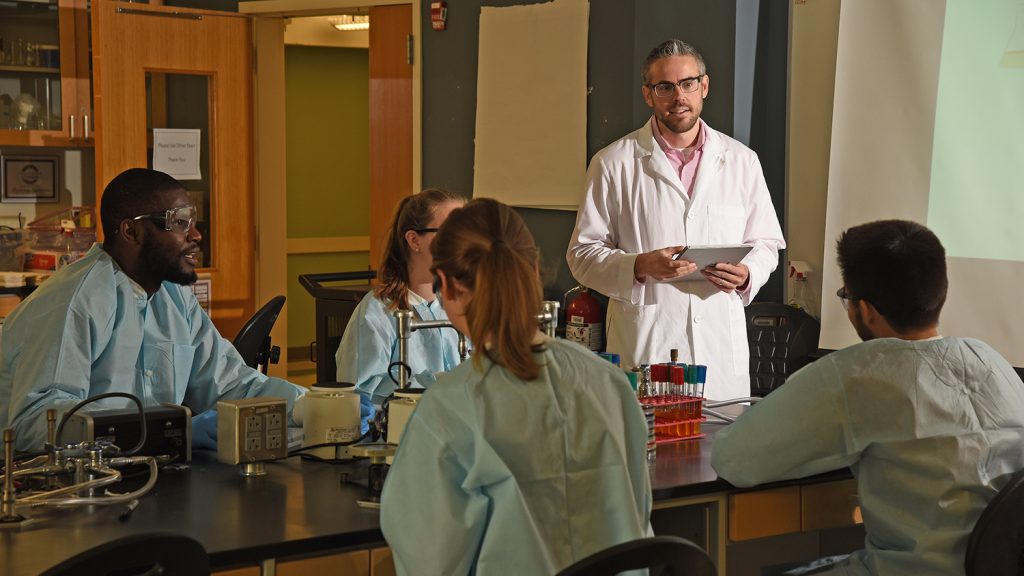
Shifting the Focus of Activity from Teacher to Learners
In the traditional approach to college teaching, most class time is spent with the professor lecturing and the students watching and listening. The students work individually on assignments, and cooperation is discouraged. Learner-centered teaching methods shift the focus of activity from the teacher to the learners.
These methods include:
- Active learning, in which students solve problems, answer questions, formulate questions of their own, discuss, explain, debate, or brainstorm during class
- Cooperative learning, in which students work in teams on problems and projects under conditions that assure both positive interdependence and individual accountability
- Inductive teaching and learning, in which students are first presented with challenges. Inductive methods include inquiry-based learning, case-based instruction, problem-based learning, project-based learning, discovery learning, and just-in-time teaching.
Learner-centered methods have repeatedly been shown to be superior to the traditional teacher-centered approach to instruction, a conclusion that applies whether the assessed outcome is short-term mastery, long-term retention, or depth of understanding of course material, acquisition of critical thinking or creative problem-solving skills, formation of positive attitudes toward the subject being taught, or level of self-confidence in knowledge and skills.
Richard Felder has written or co-authored a book and numerous papers about the use of learner-centered teaching methods in college science and engineering courses, some reporting on his own classroom research studies and some summarizing the literature. The references are listed below. Each will open in a separate browser tab. Many may be viewed and downloaded as PDF files. You may also view excerpts from an interview with Dr. Felder and see a list of good websites related to learner-centered methods.
- Teaching and Learning STEM: A Practical Guide (Felder and Brent, 2016)
- Videos and Publications on Active Learning
- Publications on Cooperative Learning
- Publications on Inductive Teaching and Learning
- Publications on Minimizing and Eliminating Student Resistance to Student-Centered Instruction
- Student-Centered Teaching and Learning Websites
Videos and Publications on Active Learning
- Active Learning with Richard Felder. A 12-minute video on YouTube in which Dr. Felder explains what active learning is and why it works and shows several illustrative clips of its use in a 125-student engineering class.
- Creating Partnerships: Active Learning in an Engineering Class. A 35-minute video on YouTube containing clips of Dr. Felder using active learning in a large class, with narration by Dr. Felder and Dr. Rebecca Brent and post-course comments from several of the students about the impact of the teaching method on their learning.
- R.M. Felder and R. Brent, “Active Learning: An Introduction.” A short tutorial that defines active learning, gives examples of activities and formats, and answers frequently-asked questions about the method. You can also take a multiple-choice quiz on the tutorial contents that provides feedback on incorrect responses.
- R. Brent, M.J. Prince, and R.M. Felder, “Promoting and Managing Student-Student Interactions in Online STEM Classes: Approaches and Recommendations.” International Journal of Engineering Education, 37(3), 797-813 (2021). Strategies for engaging students in group work in synchronous and asynchronous online courses, including discussion boards and team assignments and projects.
- M.J. Prince, R.M. Felder, and R. Brent, “Active Student Engagement in Online STEM Classes: Approaches and Recommendations.” Advances in Engineering Education, 8(4), December 2020. Strategies for actively engaging students in synchronous and asynchronous online instruction, and research supporting the effectiveness of the strategies.
- L. Bullard, R.M. Felder, and D. Raubenheimer, “Effects of Active Learning on Student Performance and Retention.” 2008 ASEE Annual Conference Proceedings, ASEE, June 2008. Exam grades and curricular retention of students taught actively in the introductory chemical engineering course were compared with grades and retention of students taught with traditional lecturing.
- R.M. Felder and R. Brent, “Learning by Doing.” Chem. Engr. Education, 37(4), 282-283 (Fall 2003). A column on the philosophy and strategies of active learning.
- R.M. Felder and R. Brent, “FAQs-2.” Chem. Engr. Education, 33(4), 276-277 (Fall 1999). Responses to the questions “Can I use active learning exercises in my classes and still cover the syllabus?” and “Do active learning methods work in large classes?“
- R.M. Felder, “Any Questions?” Chem. Engr. Education, 28(3), 174-175 (Summer 1994). Different types of questions that can be effectively asked in class.
- M. Prince, “Does Active Learning Work? A Review of the Research.” J. Engr. Education, 93(3), 223-231 (2004). A paper by Michael Prince reviewing the research evidence for the effectiveness of active learning.
- R.M. Felder, “How About a Quick One?” Chem. Engr. Education, 26(1), 18-19 (Winter 1992). Formats for small-group in-class exercises and the one-minute paper.
- R.M. Felder, “It Goes Without Saying.” Chem. Engr. Education, 25(3), 132-133 (Summer 1991). An illustrative engineering lesson utilizing active learning.
- L.G. Bullard and R.M. Felder, “A Student-Centered Approach to Teaching Material and Energy Balances. Part 2. Course Delivery and Assessment.” Chem. Engr. Education, 41(3), 167-176 (2007). Description of an implementation of the stoichiometry course that made extensive use of active and cooperative methods.
- R.M. Felder, “Stoichiometry without Tears.” Chem. Engr. Education, 24(4), 188 (1990). Tips on teaching the introductory chemical engineering course (material and energy balances), with an extended illustrative active learning exercise.
- R.M. Felder and B.A. Soloman, “Systems Thinking: An Experimental Course for College Freshmen.” Innovative Higher Education, 12(2), 57-68 (1988). Description of a course taught in 1986 that made extensive use of active learning to help students develop critical thinking and communication skills.
Publications on Cooperative Learning
General principles and strategies
- R.M. Felder and R. Brent, “Cooperative Learning.” Chapter 4 of P.A. Mabrouk, ed., Active Learning: Models from the Analytical Sciences, ACS Symposium Series 970. Washington, DC: American Chemical Society, 2007. A general overview of definitions and methods of cooperative learning and a review of CL applications in chemistry.
- R. Brent, M.J. Prince, and R.M. Felder, “Promoting and Managing Student-Student Interactions in Online STEM Classes: Approaches and Recommendations.” International Journal of Engineering Education, 37(3), 797-813 (2021). Strategies for engaging students in group work in synchronous and asynchronous online courses, including discussion boards and team assignments and projects.
- M.W. Ohland, M.L. Loughry, D.J. Woehr, L.G. Bullard, R.M. Felder, C.J. Finelli, R.A. Layton, H.R. Pomeranz, and D.G. Schmucker, “The Comprehensive Assessment of Team Member Effectiveness: Development of a Behaviorally Anchored Rating Scale for Self- and Peer Evaluation.” Academy of Management Learning and Education, 11(4), 609–630 (2013). Origins, validity, and application of the online peer rating system for cooperative learning teams that is part of the CATME Smarter Teamwork suite of tools.
- CATME Smarter Teamwork. A website containing a variety of tools for forming cooperative learning teams and helping them develop high-performance teamwork skills.
- R.M. Felder and R. Brent, Cooperative Learning in Technical Courses: Procedures, Pitfalls, and Payoffs. ERIC Document Reproduction Service, ED 377038 (1994). An introduction to the cooperative learning model of Johnson, Johnson, and Smith (references cited in the monograph), cooperative learning activities in science and engineering courses, and ways to overcome problems that may arise when this instructional approach is used.
- R.M. Felder and R. Brent, “Effective Strategies for Cooperative Learning.” J. Cooperation & Collaboration in College Teaching, 10(2), 69-75 (2001). Tips on forming teams, dealing with dysfunctional teams, grading team assignments, and using cooperative learning in a distance learning environment.
- L.G. Bullard and R.M. Felder, “A Student-Centered Approach to Teaching Material and Energy Balances. Part 2. Course Delivery and Assessment.” Chem. Engr. Education, 41(3), 167-176 (2007). Description of an implementation of the stoichiometry course that made extensive use of active and cooperative methods.
- R.M. Felder and R. Brent, “Designing and Teaching Courses to Satisfy the ABET Engineering Criteria.” J. Engr. Education, 92(1), 7–25 (2003). Review of program assessment terminology (program educational objectives, program outcomes, course learning objectives, etc.), followed by suggestions for formulating learning objectives, designing instruction, and selecting assessment methods that address Outcomes a-k of the system used to accredit all American engineering programs. Includes an appendix that outlines how cooperative learning can be used to address all 11 of those outcomes.
- R.M. Felder and R. Brent, “FAQs-3. Groupwork in Distance Learning.” Chem. Engr. Education, 35(2), 102-103 (Spring 2001).
- L. Cardellini and R.M. Felder, “L’Apprendimento Cooperativo: Un Metodo per Migliorare la Preparazione e l’Acquisizione di Abilità Cognitive negli Studenti,” La Chimica nella Scuola, 21(1), 18-25 (1999). Methods and benefits of cooperative learning. (In Italian, with an English abstract).
- R.M. Felder, “Active, Inductive, Cooperative Learning: An Instructional Model for Chemistry?” J. Chem. Ed., 73(9), 832-836 (1996).
Understanding and improving team dynamics
- B. Oakley, R.M. Felder, R. Brent, and I. Elhajj, “Turning Student Groups into Effective Teams.” J. Student Centered Learning, 2(1), 9–34 (2004). Techniques for avoiding dysfunctional teams, dealing with them when they arise, and helping students acquire the skills they will need to form high-performance teams.
- B. Oakley, D.M. Hanna, Z. Kuzmyn, and R.M. Felder, “Best Practices Involving Teamwork in the Classroom: Results from a Survey of 6435 Engineering Student Respondents.” IEEE Transactions on Education, 50(3), 266–272 (2007). How instructors form and guide teams and implement cooperative learning can have a dramatic effect on students’ satisfaction with the team experience and their sense of the extent to which the course learning objectives were met.
- C.R. Haller, V.J. Gallagher, T.L. Weldon, and R.M. Felder, “Dynamics of Peer Education in Cooperative Learning Workgroups.” J. Engr. Education, 89(3), 285-293 (2000). Conversation analysis of work sessions of student groups is used to identify patterns of teaching-learning interactions and interactional problems.
Accounting for individual effort in teamwork
D.B. Kaufman, R.M. Felder, and H. Fuller, “Accounting for Individual Effort in Cooperative Learning Teams.” J. Engr. Education, 89(2), 133-140 (2000). Experimental study of the use of a peer rating system in an introductory engineering course. The study examines the incidence of students receiving low ratings from all their teammates, inflated and deflated self-ratings, identical ratings given by all teammates to one another, and possible gender and racial bias in the ratings.
A longitudinal study of cooperative learning
- R.M. Felder, “A Longitudinal Study of Engineering Student Performance and Retention. IV. Instructional Methods and Student Responses to Them.” J. Engr. Education, 84(4), 361–367 (1995). A detailed outline of an instructional approach that incorporates active and cooperative learning and a variety of other methods designed to address a broad spectrum of learning styles.
- R.M. Felder, G.N. Felder, and E.J. Dietz, “A Longitudinal Study of Engineering Student Performance and Retention. V. Comparisons with Traditionally-Taught Students.” J. Engr. Education, 87(4), 469-480 (1998). Performance and attitude differences between students taught with the active/cooperative learning model described in the previous reference and students taught with a traditional instructor-centered model.
- R.M. Felder, “Cooperative Learning in a Sequence of Engineering Courses: A Success Story.” Cooperative Learning and College Teaching Newsletter, 5(2), 10-13 (1995). A synopsis of the preceding two references.
Forms for cooperative learning. A set of forms that can be modified and used to form teams, establish course policies regarding teams, and help teams set expectations and assess their individual and team performance. Also included are checklists for implementing cooperative learning in lecture classes, project courses, and laboratories, and a list of CL-related publications and websites.
Publications on Inductive Teaching and Learning
- M.J. Prince and R.M. Felder, “Inductive Teaching and Learning Methods: Definitions, Comparisons, and Research Bases.” J. Engr. Education, 95(2), 123-138 (2006). Descriptions of several common inductive methods, including inquiry learning, problem-based and project-based learning, discovery learning, case-based teaching, and just-in-time teaching, and a survey of their applications in engineering education and the research base that confirms their effectiveness.
- M.J. Prince and R.M. Felder, “The Many Faces of Inductive Teaching and Learning.” J. College Science Teaching, 36(5), 14-20 (2007). Pros, cons, and comparisons of several different inductive teaching methods (inquiry-based learning, discovery learning, problem- and project-based learning, case-based teaching, and just-in-time teaching). The paper describes illustrative applications of these methods in the sciences and offers guidance on their implementation.
Publications on Minimizing and Eliminating Student Resistance to Student-Centered Instruction
- R.M. Felder and R. Brent, “Navigating The Bumpy Road to Student-Centered Instruction.” College Teaching, 44(2), 43-47 (1996). The origins and patterns of student resistance to active and cooperative learning, and suggested ways to deal with the resistance.
- R.M. Felder, “Sermons for Grumpy Campers.” Chem. Engr. Education, 41(3), 183-184 (Summer 2007). Short speeches to persuade students that active and cooperative learning are not violations of their civil rights, but instructional methods likely to improve their learning and grades and prepare them for their future careers.
- R.M. Felder, “Hang in There: Dealing with Student Resistance to Learner-Centered Teaching.” Chem. Engr. Education, 45(2), 131-132 (Spring 2011). If you tried active or cooperative or problem-based learning and got pushback and lower ratings from the students and feel discouraged, here are some things to think about.
Student-Centered Teaching and Learning Websites
- National Center for Case Study Teaching in Science. A large collection of resources for case-based instruction housed at the University of Buffalo.
- The ChemCollective. Resources for inquiry-based learning in chemistry.
- Process-Oriented Guided Inquiry Learning (POGIL). Information about and resources for a team-based approach to inquiry learning that has been applied principally in chemistry curricula.
- Problem-Based Learning Clearinghouse. Problems that have been used as the basis of PBL activities in different disciplines and articles about PBL.